We spent years on the vendor side building AI for community banks. We know how that conversation goes: the vendor presents what they're shipping, the bank tries to map it to their needs, and nobody asks where the industry is headed or whether any of this builds toward something. That's the question we start with.
Before starting Upstate AI, our founder was COO at Directlink, a company that built conversational AI for community banks and credit unions. We know what the pitch deck says. We know what actually ships.
FIS, Jack Henry, and Fiserv control 70%+ of the core banking market. When any of them says AI features are "on the roadmap," that typically means 18 to 36 months, and you will have signed a contract before you find that out. We will help you ask the right questions before you sign.
Vendor demos show AI working on clean, structured data. Most community banks don't have that. A demo that works in a controlled environment will behave very differently on your actual customer data and your actual core system.
The AI model is rarely the hard part. Connecting it to your core, your loan origination system, and your compliance workflows is where most implementations stall. Vendors underscope this every time. We build that into the roadmap from day one.
If your data is fragmented across systems that don't talk to each other, AI will amplify that problem, not fix it. If you haven't solved your data quality issue, an AI layer on top makes it worse and more expensive. We will tell you this in the first conversation if it applies to you.
Community banks are caught between forces pulling in every direction.
Three core providers control 70%+ of the market. Their AI roadmaps don't match your timeline, so nothing moves.
Customers use Chase's app on Monday and walk into your branch on Tuesday. They expect both to feel modern.
Experienced staff retiring. Younger hires expect modern tools. Manual processes create bottlenecks with a lean team.
Compliance obligations multiply while your team stays the same size. Regulators are watching how you use AI and how you don't.
Fast approvals. Personalized advice. 24/7 access. They chose you for the relationship. They'll leave if the tech falls behind.
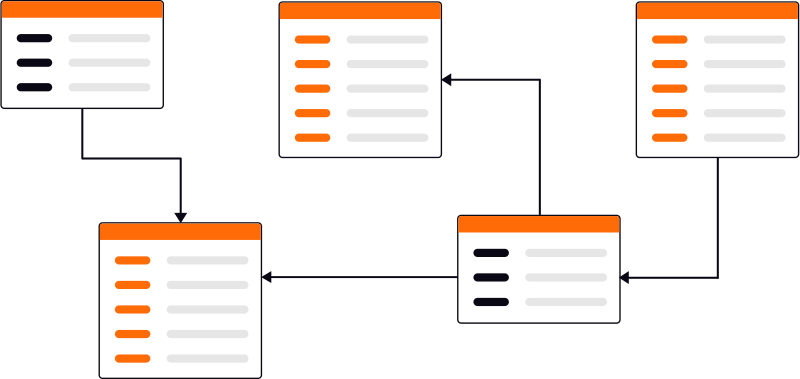
Customer data scattered across core, CRM, and loan origination. None of it talks to each other. AI needs connected data to work.
None of these problems are going away. But every one of them is a problem AI can help solve, without turning your bank into something it's not.
We start with one problem, not all six. The areas below represent the full scope of where AI creates value for community banks. In your first engagement, we identify which applies to your institution, in what order, and at what cost.
AI handles the tedious. Your staff focus on judgment, relationships, and local knowledge.
AI makes relationships easier to maintain and harder for big banks to replicate.
Your platforms need to talk to each other. AI makes that happen.
AI layers on top of your existing systems. No rip-and-replace required.
AI makes compliance less manual and more consistent.
AI strengthens the relationship-based approach. It doesn't replace it.
Large banks spend billions simulating personal relationships. You have the real thing. AI makes it operational at scale.
AI turns your bankers' institutional knowledge into data models that inform lending, risk, and outreach.
Customers trust your bank with their data. That trust is the foundation for AI personalization they welcome.
AI gives each commercial relationship the attention of a dedicated advisor. Reinforced with better data, not replaced.
No 18-month committee approvals. Build capabilities on your timeline, not your core vendor's.
You don't need to compete on volume or R&D budget. AI lets you compete on what you already own: local knowledge and real relationships.
The assessment is not a sales call. It is a working session. We will look at your current systems, your customer data, your staffing model, and your compliance situation and tell you honestly what AI can and cannot do for your bank right now. If the answer is "not yet," we will tell you that too.
Clients typically identify $50,000 or more in annual operational savings opportunities in a single workshop session. We'll tell you where yours are, or tell you if we can't find them.