The data to run a better operation is already in your plant. AI connects it and surfaces what your team can't see manually. I've built AI products, sold them, and know exactly where vendor promises and operational reality diverge.
The same patterns show up at manufacturers across industries. The equipment is different. The operational blind spots are not.
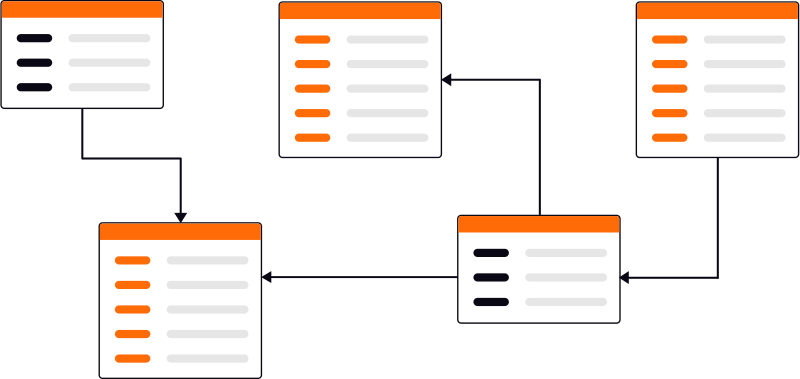
Your machines, ERP, quality systems, and maintenance logs all generate data. None of it talks to each other in real time. The insights are there, buried in silos. AI connects them.
You fix equipment after it breaks. Scheduled preventive maintenance helps but doesn't predict failures before they cause downtime. Predictive AI changes the calculus on both cost and unplanned stops.
Defects caught at end-of-line or by the customer. Root cause takes days to trace. AI-based inspection and process monitoring catches drift before it becomes scrap or a return.
You know what you ordered. You often don't know where it is, what's at risk, or how a delay cascades into your production schedule. AI gives you that picture before the call from your supplier does.
Manufacturers face the same complexity as larger competitors with a fraction of the resources.
One equipment failure on a critical line can cost tens of thousands of dollars per hour. Reactive maintenance is an expensive and avoidable way to run a plant.
Defects that reach the customer erode relationships and drive warranty costs. End-of-line inspection catches problems after you've already spent the production cost.
Customer orders shift faster than your inventory and production planning cycles. Safety stock is expensive. Stockouts are worse. Forecasting accuracy matters more than it used to.
Experienced operators and technicians retiring. Institutional knowledge walking out the door. Onboarding new staff to complex processes takes time you don't have.
Single-source dependencies, long lead times, and limited supplier visibility. Disruptions that were rare are now routine. You need earlier warning than you're getting.
Your ERP captures transactions. It doesn't tell you why yield dropped on Line 3 last Tuesday or which supplier is most likely to miss next month's delivery.
These aren't problems you hire your way out of. They require better use of the operational data you're already generating. That's exactly what AI is built to do.
We don't start with the technology. We start with your highest-cost operational problems and work backward to the right AI approach.
Know when equipment is going to fail before it does. Shift from reactive to proactive and reduce unplanned downtime significantly.
Catch process drift and defects earlier, before they become scrap, rework, or customer returns.
Better forecast accuracy means less safety stock, fewer stockouts, and a production schedule that doesn't have to be rebuilt every week.
Find the parameter combinations that maximize yield, reduce cycle time, and lower energy consumption, across thousands of variables your team can't manually track.
Earlier warning on supplier risk, delivery delays, and demand shifts, before they disrupt your production schedule.
Document what your experienced operators and technicians know before it walks out the door. Make that knowledge accessible to everyone on the floor.
Most manufacturers are sitting on years of production, quality, and maintenance data they've never fully used. AI turns that backlog into competitive intelligence.
The vibration, temperature, and pressure readings your equipment already generates contain failure signatures. AI reads them months before the breakdown.
Years of production runs contain the patterns that distinguish your best shifts from your worst. AI finds them and turns them into process recipes your operators can actually use.
Large manufacturers move slowly. You can deploy AI in weeks where they take years. That speed is a structural advantage if you use it.
Fewer quality escapes and better delivery reliability protect the relationships that differentiate you from commodity manufacturers.
AI gives manufacturers the operational intelligence of large enterprises, without the IT department or the nine-figure ERP investment.
The assessment is a working session focused on your plant. We look at your highest-cost operational problems, your current data infrastructure, and your team's capacity and tell you honestly where AI creates real leverage and where it doesn't. If the answer is "not yet," we'll say that.
Your data doesn't have to be perfect to start. Most manufacturers we work with have inconsistent sensor data, messy ERP exports, or maintenance logs that still live in spreadsheets. That's normal. We scope to what's usable and tell you specifically what would improve the picture.
Clients typically identify $50,000 or more in annual operational savings opportunities in a single workshop session. We'll show you where yours are, or tell you if we can't find them.